Luxor, West Bank. In the quiet of Upper Egypt, painter Alaa Abu Elhamd develops a body of work rooted in memory, intimacy and ancient Egyptian philosophy. We went on a journey from Karnak temple to his studio to discuss how his paintings bridge personal experience with myth.
From village walls to fine arts
Born in Qena, in the village of Abu Manna Bahri, Abu Elhamd grew up surrounded by traces of ancient civilisation. His first artistic influence was his father, a painter of traditional Hajj murals. Watching him paint directly onto walls shaped his perception of art as something alive and embedded in daily life.
“Our houses speak,” he says. “They carry stories.”
After studying history, he joined the Faculty of Fine Arts in Luxor, where exposure to ancient Egyptian art refined his visual language.
Painting memory: the intimacy of waiting
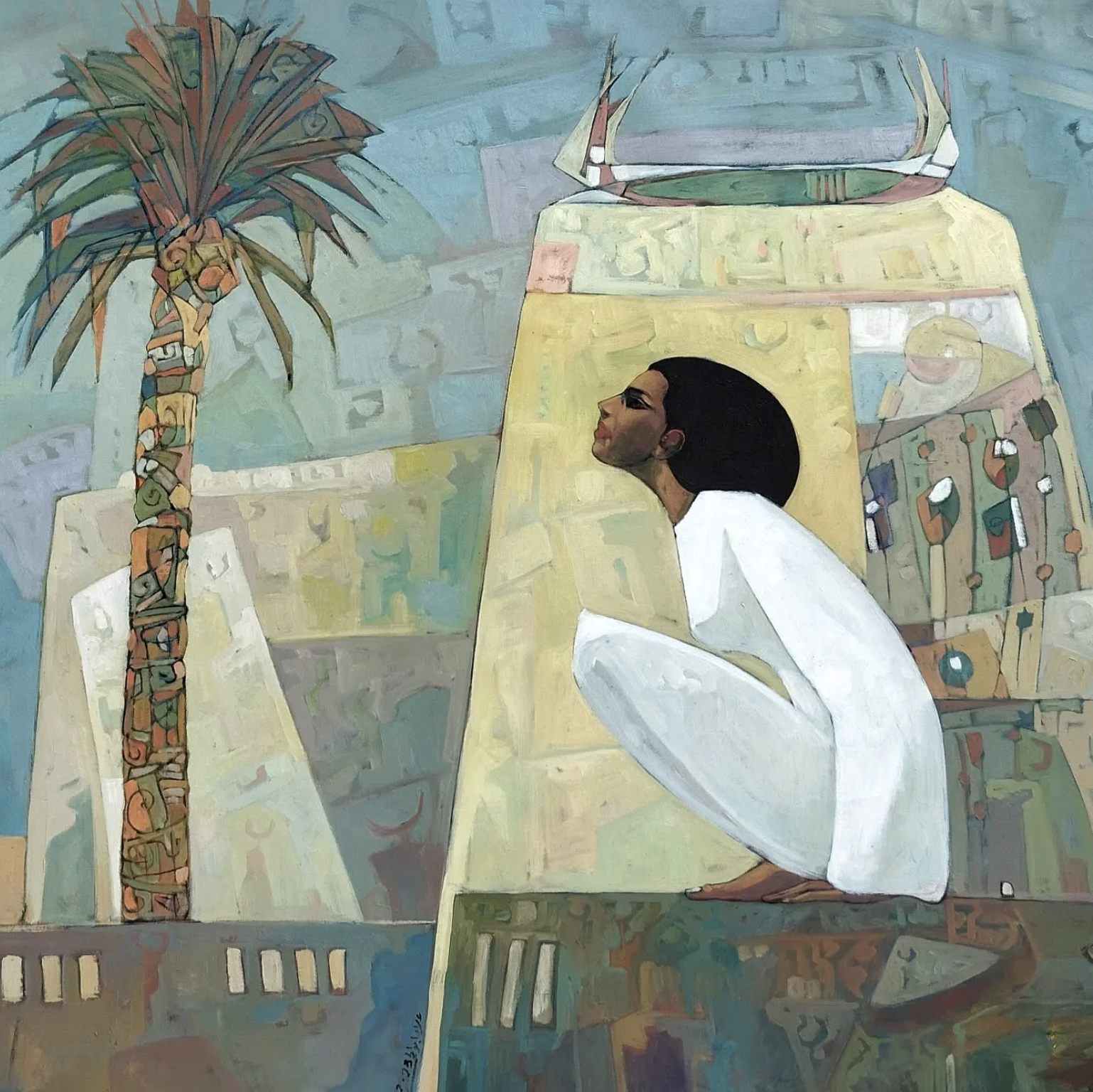
His work often begins with personal memories. In one painting, he depicts his mother waiting on the roof for his father to return home. For him, waiting is not absence, but love and anticipation.
“It’s the joy of someone coming back,” he explains.
These scenes are simple, yet emotionally charged, transforming intimate moments into universal experiences.
Reimagining the afterlife
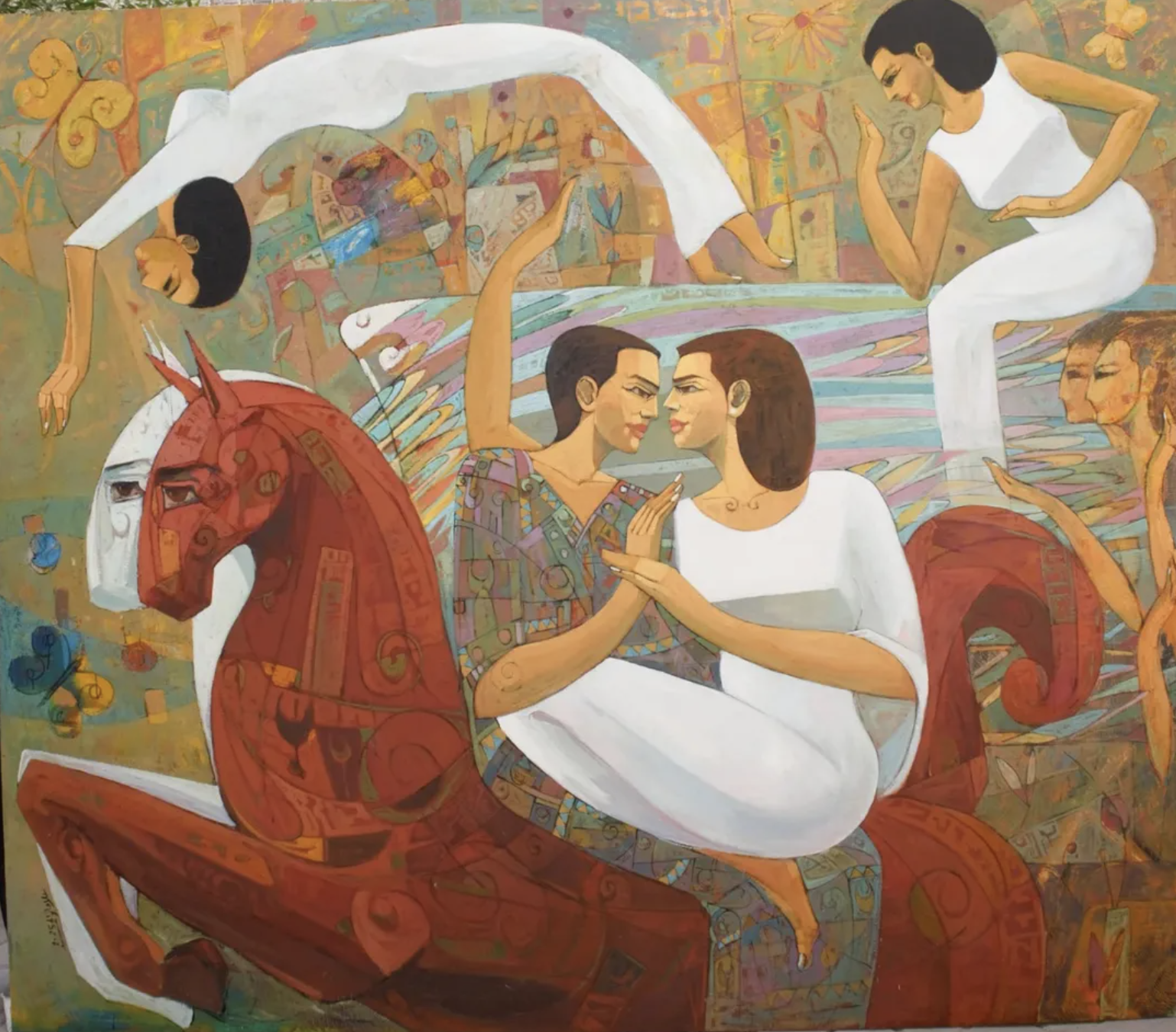
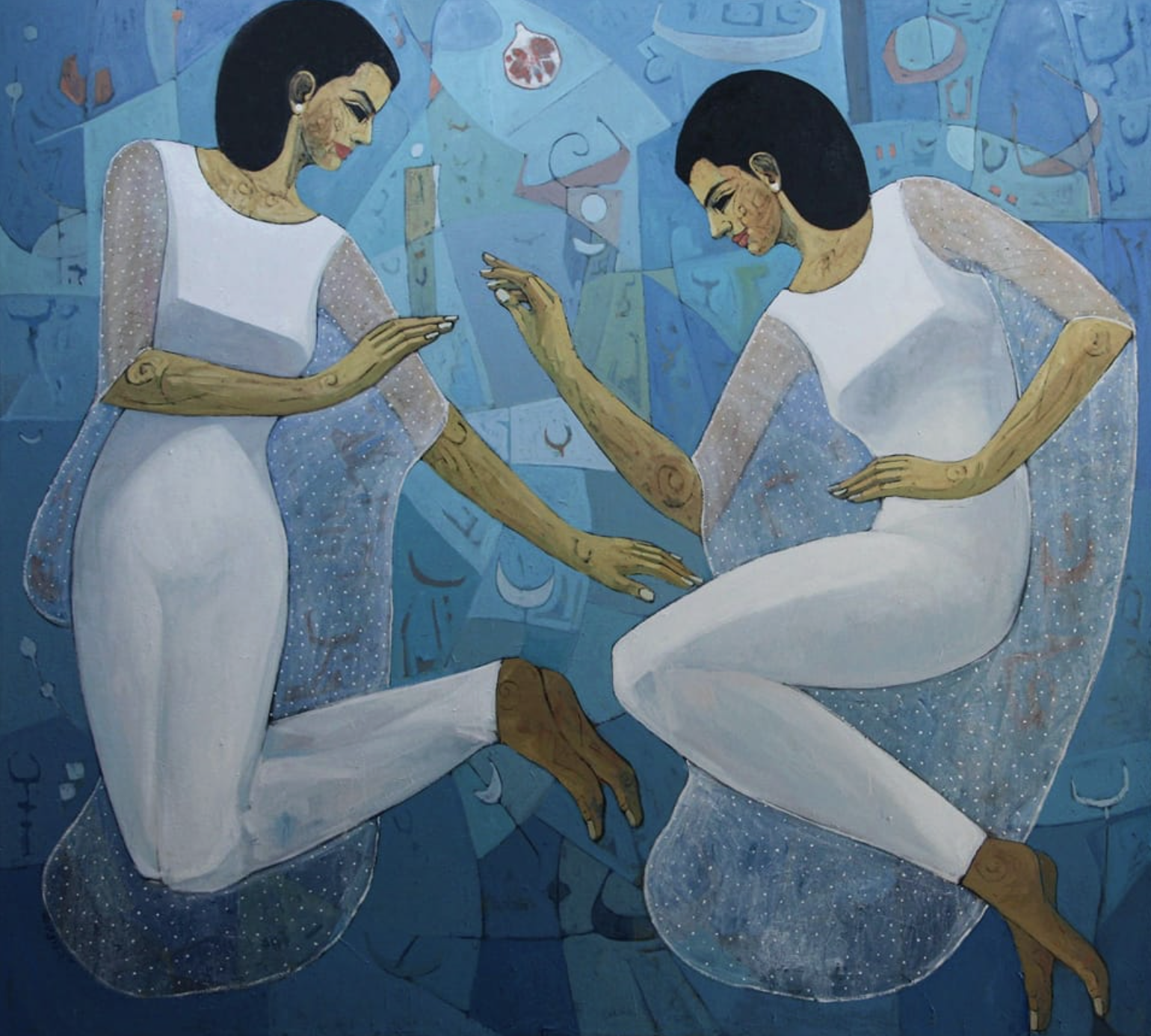
A central theme in his practice is “The Fields of Iaru”, inspired by ancient Egyptian visions of the afterlife. Rather than a fixed place, paradise becomes a personal, imagined space. Figures float, fly, and move through undefined landscapes. By blending mythology with personal narrative, he brings ancient philosophy into a contemporary perspective.
“In my world, paradise has no ground,” he says. “It’s a place to fly.”
The feminine figure as one
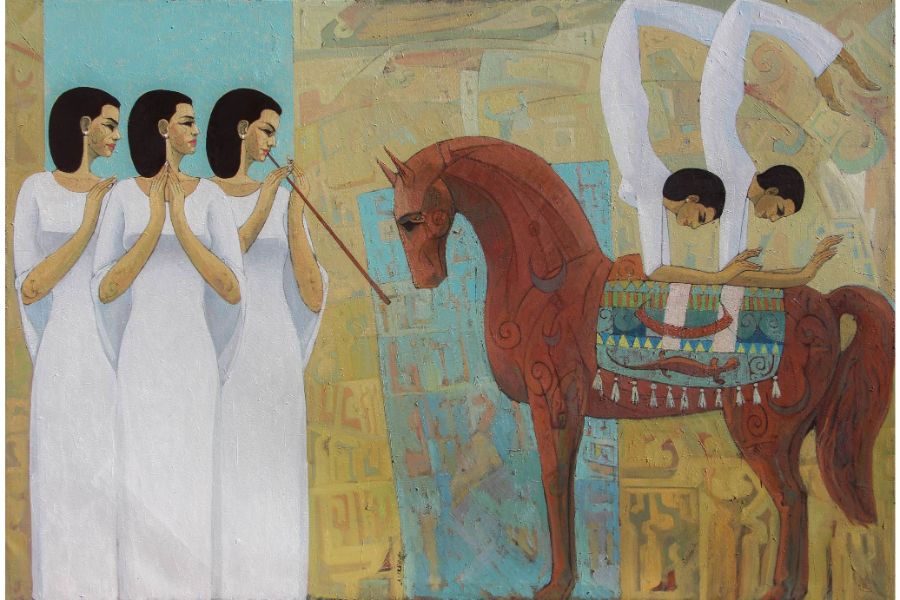
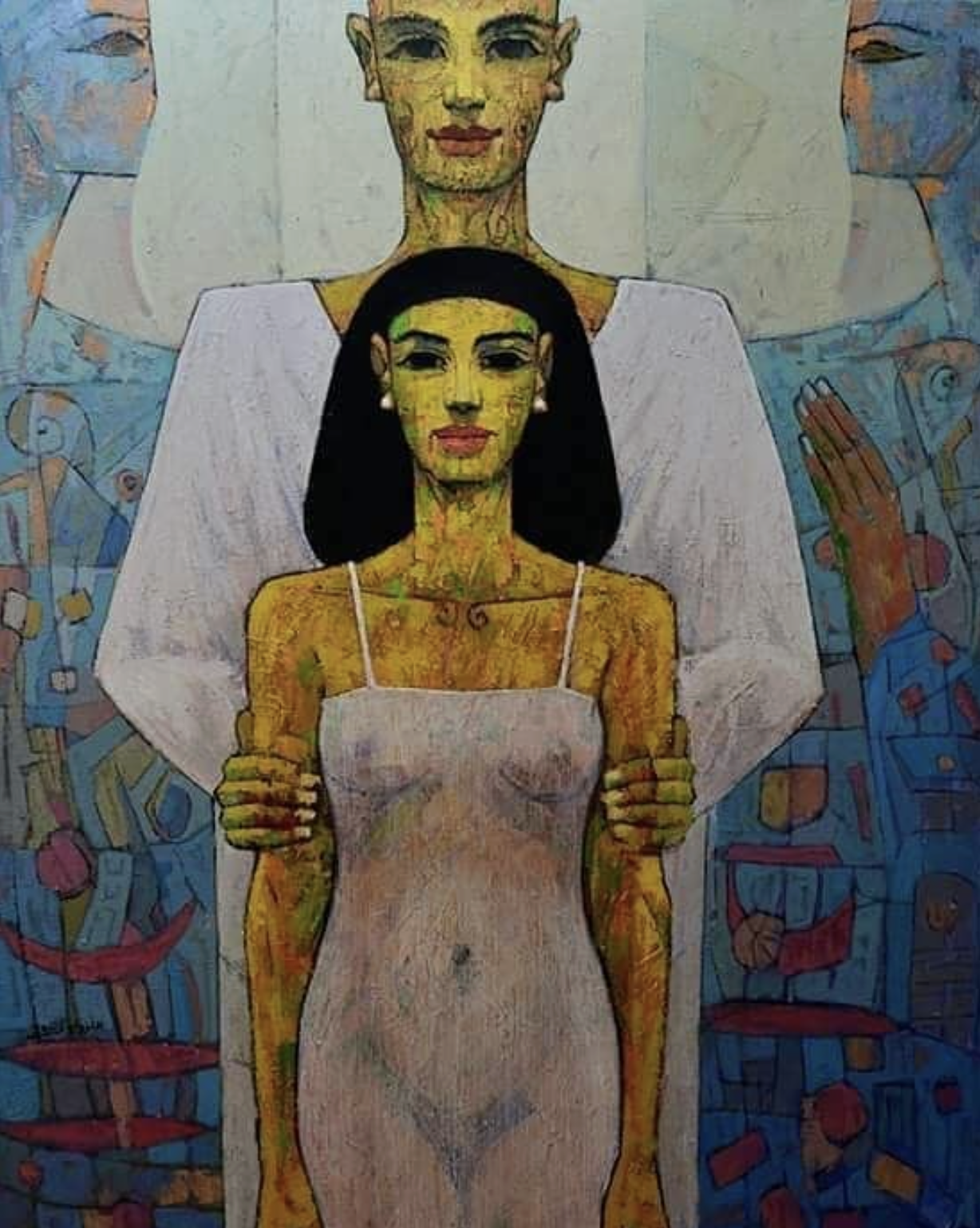
A recurring presence in his work is a single female figure embodying multiple roles, inspired by his own mother, wife and daughter.
“I merge them into one,” he explains.
This figure becomes symbolic rather than individual, representing intimacy, protection and somehow, continuity.
Colour, stillness and inner movement
His palette is rooted in Upper Egyptian tradition: blue, white and red. White, in particular, holds a central place, both visually and symbolically. His figures are static, almost sculptural. Inspired by ancient Egyptian art, movement is internal rather than physical. Dark eyes and solid forms add depth and mystery, inviting interpretation rather than imposing it.
“Stillness creates power,” he says.
Art, authenticity and rejection of AI
For the artist, art is a personal transformation shaped by lived experience.
“Anyone can be an artist,” he says. “It’s about how you reshape reality.”
He is critical of artificial intelligence in art, seeing it as disconnected from emotion and experience.
“An artwork is the result of a whole life,” he insists. “Not something made in minutes.”
Luxor as a source of energy
Luxor is central to his process. Before exhibitions, he visits sites like Karnak to reconnect with what he describes as their spiritual energy.
“The way you start with the courtyard and the hypostyle hall, then the place gradually narrows until you reach the Holy of Holies: it’s spiritual purification,” he says.
This sense of inner transformation is reflected in both his themes and compositions.
Abu Elhamd continues to explore ancient Egyptian symbols through a contemporary lens, particularly in his ongoing work around the Fields of Iaru and Nile landscapes.
His work is not about recreating the past, but inhabiting it differently. A quiet dialogue between memory, imagination and heritage.
FIND OUT MORE
Instagram: @alaa_abuelhamd
All artworks © Alaa Abu Elhamd
Podcast episode available: Spotify, Apple Podcasts, Anghami.
This interview has been edited for length and clarity.